
Enterprise Content Management: An Investment That Pays Off.

Document management is crucial in modern organizations, where speed, collaboration and compliance are becoming increasingly important.
Managing content across different systems and departments is often complex and error-prone.
With an ECM platform, you no longer need to worry about this and information management becomes simple, secure and fully automated.
"Ishtar365 ensures you never waste time searching for documents again, with one central place and smart automation for all your business information."
What are the essential components of Enterprise Content Management?
1. Document Management
The digital management, storage and retrieval of documents, including version control and access security, and in compliance with legal and compliance requirements.
2. Workflow & Business Process Automation
Automating processes (for example approval flows) so that the workflow runs faster, errors are reduced and employees can focus on valuable tasks.
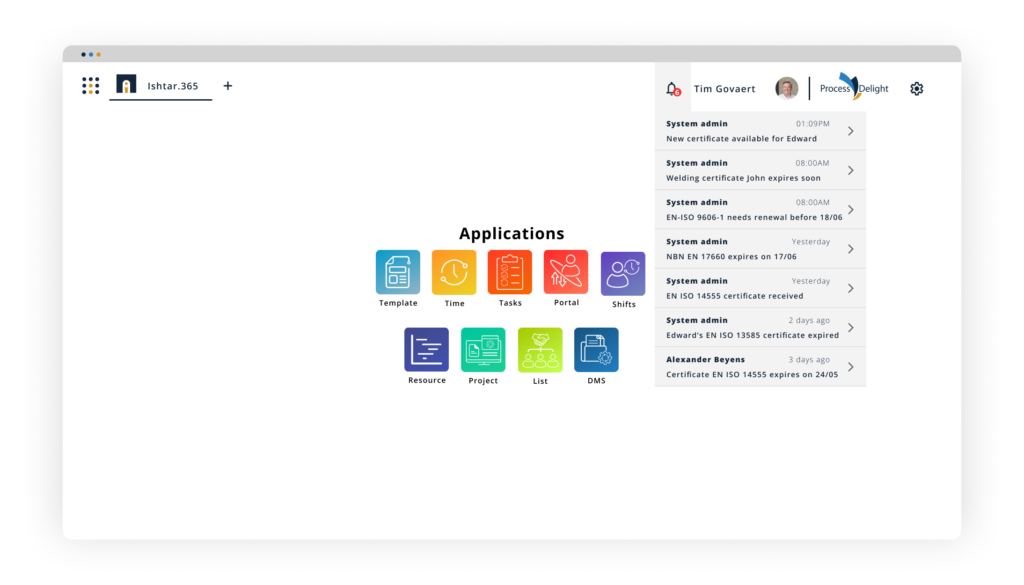
3. Collaboration Tools
Enabling teams to easily collaborate on the same information, internally and externally (e.g. via portals).
Boost your Microsoft 365 investment with ECM
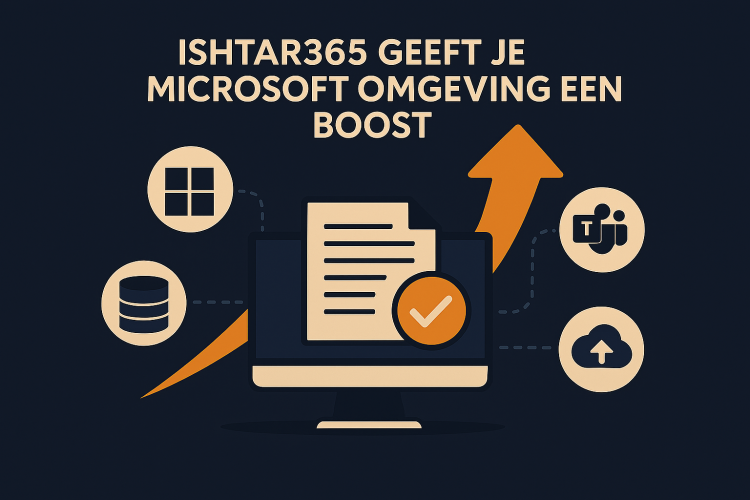
Microsoft 365 is the leader in the digital productivity market, with more than 80 percent of the global market share. Although Microsoft 365 has powerful and user-friendly tools for document management, work processes and collaboration, these advantages can also cause problems. With the growing set of Microsoft 365 tools, employees can increasingly easily create, duplicate and share new content with others. Positive of course, but the risk of fragmented information, content hidden in closed channels and therefore inadequate transparency and compliance increases dramatically.
Forward-thinking organizations are therefore increasingly choosing a Content Management solution to strengthen the power of their Microsoft 365 environment, secure information processes and guarantee compliance without sacrificing the advantages in terms of productivity and efficiency. Although Microsoft with SharePoint, OneDrive, Teams, etc. offers powerful data storage and management tools, the Microsoft 365 suite contains no ready-made plans for information management. This leads to multiplication of documents, failing version control and inefficient and potentially dangerous access management. Employees waste a lot of time searching for information, become frustrated and create their own storage methods, leading to reduced productivity and security.
And we have not even mentioned the production employees or other workers, who almost never have a Microsoft 365 account from their organization. Yet this group of employees also creates and consumes (digital) content, e.g. consulting work instructions or safety regulations, reporting incidents or reporting absences.
An Enterprise Content Management platform connects Microsoft and non-Microsoft systems and users, to create a single source of truth across all business data. It provides search capabilities based on content rather than location, using metatags. ECM provides control over document access, versions, publication and distribution, both for knowledge workers and production employees.
What Return on Investment can you expect from an Enterprise Content Management system?
Time is money
Many organizations struggle with documents that are scattered everywhere. On servers, in emails, Teams groups, personal drives or even in paper folders. The result? Lost time, frustration and higher costs. According to a McKinsey study (2023), professionals spend 1.8 hours per day searching for and validating information. With ECM you save up to 40% search time, i.e. a net gain of 45 minutes per day per employee.


Smarter collaboration
Whether you collaborate with internal teams or external stakeholders: ECM makes sharing information simple, also to a larger group of interested parties. No more maintaining mailing lists in separate email apps. Via flexible and easy-to-set-up portals, you make the right content available to each target audience. You can record appointments, ask for feedback, post news items, etc.
Work faster through automation
ECM software platforms generally offer no-code tools for process automation. This allows employees to digitize their own daily tasks and have them run as automatically as possible, also in collaboration with colleagues. This saves a lot of manual work, reduces errors and speeds up service delivery.

Compliance without headaches
Regulations around data and privacy are becoming increasingly strict. With ECM you can very easily and clearly manage access to information, using metatags. Personal data is optimally protected and can be deleted immediately and without losing time, e.g. as a task within an offboarding process. Audits and reports take less time and fines due to errors are avoided.
Return on Investment
The ROI of ECM does not come from one advantage, but from a combination of time savings, lower costs, better collaboration and less risk. Enterprise Content Management is therefore not an IT cost, but a strategic investment. It makes organizations smarter, faster and ready for the AI-driven future.



Stay informed.
Sign up for our newsletter and receive the latest insights & updates about future-proof working directly in your mailbox.